Physical AI Radar · 2026-09-20
A daily radar on the Physical AI frontier: eight lanes, trilingual digests, traceable evidence.
- Generated:
2026-09-20 01:51 UTC - Window:
2026-09-17 → 2026-09-20 (UTC) - Evidence tags: O = first-party official · R = paper/preprint · M = media/secondary
Today’s picks
1. Robots Are Learning to Feel
- Lane: Data engine (collection / curation / scaling) | Evidence:
[M]| Source: IEEE Spectrum Robotics |2026-09-10 - Key numbers:
100 hours·12 tasks·3,000 hours·30,000 hours - quantitative results / closed-loop success reported / real-robot experiments / latency or control-rate numbers
- Why it matters: Data sourcing and curation pipelines are the real moat today; they set the cost per new task.
Dexterous manipulation remains one of the biggest barriers keeping robots from successfully tackling a wide range of everyday tasks.
2. Video Friday: Two Birotors Make a Quadrotor
- Lane: Simulation & evaluation (sim2real / closed-loop) | Evidence:
[M]| Source: IEEE Spectrum Robotics |2026-09-18 - Key numbers:
33%·2x - closed-loop success reported / latency or control-rate numbers
- Why it matters: Evaluation method decides what you dare to ship: offline metrics are not closed-loop success, and the evaluation budget is shifting from human hours to GPU hours.
Video Friday is your weekly selection of awesome robotics videos, collected by your friends at IEEE Spectrum robotics.
3. Fine-Tuning π0 (Pi-Zero) for robotic manipulation on Amazon SageMaker HyperPod EKS
- Lane: Foundation models (VLA / WAM) | Evidence:
[O]| Source: AWS Physical AI Blog |2026-09-10 - real-robot experiments
- Why it matters: Changes at the foundation-model layer reset the starting point for every downstream task: how much of your own data you need, and whether it transfers across embodiments.
Introduction This post demonstrates how to fine-tune π0 (Pi-Zero), a 3-billion parameter flow matching Vision-Language-Action model from Physical Intelligence, on robot manipulation datasets using Amazon SageMaker HyperPod with Amazon…
4. Digit 5 May Be the First Humanoid Robot Worker That’s Truly Safe
- Lane: Embodiment & supply chain (hardware / cost) | Evidence:
[M]| Source: IEEE Spectrum Robotics |2026-09-15 - Key numbers:
20 hours - quantitative results / latency or control-rate numbers
- Why it matters: Embodiment and supply chain set the cost curve and delivery cadence; actuators remain the dominant share of BOM.
Despite the recent deluge of videos of humanoid robots doing backflips and kung fu, the actual pace of progress towards humanoids that can do economically viable jobs at scale has at times seemed a bit plodding.
5. Video Friday: Meet Microduck
- Lane: Embodiment & supply chain (hardware / cost) | Evidence:
[M]| Source: IEEE Spectrum Robotics |2026-08-28 - quantitative results / real-robot experiments / open code or weights / latency or control-rate numbers
- Why it matters: Embodiment and supply chain set the cost curve and delivery cadence; actuators remain the dominant share of BOM.
Video Friday is your weekly selection of awesome robotics videos, collected by your friends at IEEE Spectrum robotics.
6. Video Friday: Digit Redecorates
- Lane: Simulation & evaluation (sim2real / closed-loop) | Evidence:
[M]| Source: IEEE Spectrum Robotics |2026-09-04 - real-robot experiments / open code or weights
- Why it matters: Evaluation method decides what you dare to ship: offline metrics are not closed-loop success, and the evaluation budget is shifting from human hours to GPU hours.
Video Friday is your weekly selection of awesome robotics videos, collected by your friends at IEEE Spectrum robotics.
7. NVIDIA Vera Rubin NVL72 Delivers Leading Performance in MLPerf Inference v6.1 Debut
- Lane: Edge & real-time (on-device inference / control rate) | Evidence:
[O]| Source: NVIDIA Blog |2026-09-16 - latency or control-rate numbers
- Why it matters: On-device latency and control rate are hard constraints: however capable the model, it cannot enter the control loop if it misses the real-time budget.
System performance, efficient infrastructure scaling and continuous software optimization are key levers that determine AI inference economics.
8. Cute Critters Come to the Cloud: ‘Aniimo’ Launches on GeForce NOW
- Lane: Training & self-improvement (RL / post-training) | Evidence:
[O]| Source: NVIDIA Blog |2026-09-17 - Why it matters: Post-training and self-improvement decide whether a policy keeps getting better after deployment, and whether operations must capture intervention data.
A new creature-catching adventure is ready to stream from the cloud this week. Pawprint Studio’s Aniimo arrives on GeForce NOW at launch, inviting gamers to explore the vibrant continent of Idyll across supported devices.
Frontier baseline (curated)
1. Post-train NVIDIA Cosmos 3 Edge for on-device robot control
- Lane: Edge & real-time (on-device inference / control rate) | Evidence:
[O]| Source: NVIDIA Technical Blog |2026-08 - Key numbers:
4B omni-model·2B Nemotron reasoner·runs on Jetson Thor·receding-horizon control loop - closed-loop success reported / open code or weights
- Why it matters: The first reproducible path for a world model on-device: post-train, serve on Thor, then evaluate closed-loop, with code and checkpoint released.
2. Fine-tuning π0 for robotic manipulation on Amazon SageMaker HyperPod EKS
- Lane: Training & self-improvement (RL / post-training) | Evidence:
[O]| Source: AWS Physical AI Blog |2026-09-10 - Key numbers:
MSE -89.7% (DROID)·MSE -88.9% (LIBERO)·8xH100, 20k steps, 6h15m·50-step chunk <200 ms at 1 ODE step·checkpoint ~45 GB - Why it matters: An earlier version of the same work reported ~96% because eval episodes overlapped training; enforcing the split moved it to ~89%. The best evaluation-discipline case of 2026.
3. EgoScale: scaling dexterous manipulation with diverse egocentric human data
- Lane: Data engine (collection / curation / scaling) | Evidence:
[R]| Source: arXiv 2602.16710 |2026 - Key numbers:
44k hours of egocentric video·+54% average success vs no-pretraining on a 22-DoF hand·transfers to lower-DoF hands - Why it matters: Large-scale human motion is shown to be a reusable, embodiment-agnostic motor prior, so dexterous hands do not start from zero.
4. PL-CBF: finite-horizon safety at runtime via parallel fallback rollouts
- Lane: Safety, authority & compliance | Evidence:
[R]| Source: arXiv 2605.16588 |2026 - Key numbers:
library of fallback policies·least-invasive safe mode·QP minimally modifies the nominal policy - Why it matters: ‘Least-invasive fallback’ can go straight into customer acceptance criteria - far more concrete than ‘we are safe’.
5. LeRobotDataset v3.0: a standardised, streamable format for robot learning data
- Lane: Data engine (collection / curation / scaling) | Evidence:
[O]| Source: Hugging Face |2026 - Key numbers:
Parquet + MP4 + relational metadata·multi-episode packing·native streaming for multi-TB datasets - Why it matters: The format question is converging on LeRobot v3 for data and OpenUSD for assets; data you can convert in one step is worth far more than the same hours locked in a private format.
6. HumanEgo: zero-shot robot learning from minutes of human egocentric video
- Lane: Data engine (collection / curation / scaling) | Evidence:
[R]| Source: arXiv 2605.24934 |2026 - Key numbers:
30 min/task -> 92.5% average success on 4 real tasks·15 min -> 75%·+41% over matched-time teleoperation - Why it matters: It pushes the cost per new task down to minutes of data - the most direct yardstick for whether your data strategy is behind.
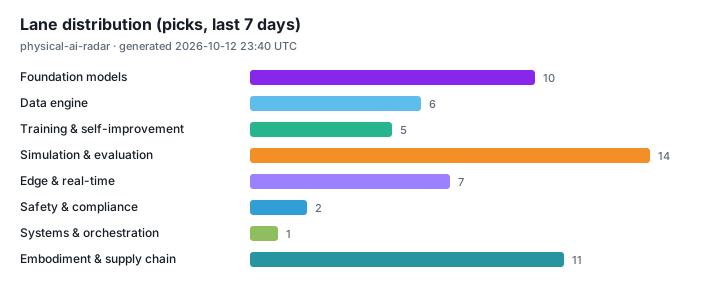
Lane distribution
| Lane | # |
|---|---|
| Foundation models (VLA / WAM) | 4 |
| Data engine (collection / curation / scaling) | 6 |
| Training & self-improvement (RL / post-training) | 5 |
| Simulation & evaluation (sim2real / closed-loop) | 6 |
| Edge & real-time (on-device inference / control rate) | 6 |
| Safety, authority & compliance | 5 |
| Systems & orchestration (long-horizon / multi-policy) | 1 |
| Embodiment & supply chain (hardware / cost) | 4 |
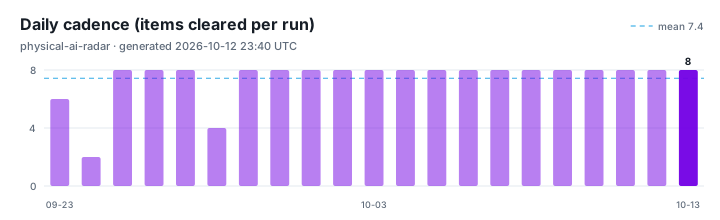
Recent cadence

Standards & compliance watch
- ISO 25785-1 — Safety requirements for dynamically stable industrial mobile robots — Under development; committee-stage as of 2026-09.
- Regulation (EU) 2023/1230 (Machinery Regulation) — Fully applicable 2027-01-20.
- EU AI Act official timeline (Council of the EU) — High-risk deadlines 2027-12-02 / 2028-08-02 per Digital Omnibus.
This repository is technical observation. It is not investment advice, a product commitment, or a safety certification conclusion. Paper claims are author-reported.