Physical AI 前沿雷达 · 2026-09-19
每日自动更新的具身智能前沿雷达:八条主线、三语精炼、证据可查。
- 生成时间:
2026-09-19 08:12 UTC - 统计窗口:
2026-09-16 → 2026-09-19 (UTC) - 证据标注:O = 一手官方 · R = 论文/预印本 · M = 媒体或二手
今日重点
1. GeoAAC: Geometry-Based Adaptive Action Chunking from Denoising Trajectories in VLA Policies
- 主线: 基座模型(VLA / WAM) | 证据:
[R]| 来源: arXiv 2609.20776v1 |2026-09-17 - 含闭环成功率 / 含真机实验
- 为什么重要: 基座模型层的变化会直接决定下游所有任务的起点:它影响你需要多少自有数据、能不能跨本体迁移。
Action chunking is widely used for action generation and execution in Vision-Language-Action (VLA) policies, yet existing approaches commonly use a fixed action horizon.
2. rMuscle: Robotic Muscle Memory for Efficient Vision-Language-Action Model Inference
- 主线: 边缘与实时性(端侧推理 / 控制频率) | 证据:
[R]| 来源: arXiv 2609.19104v1 |2026-09-16 - 含闭环成功率 / 含真机实验 / 含延迟或控制频率
- 为什么重要: 端侧延迟与控制频率是硬约束:模型再强,超出实时预算就不能进入控制回路。
Factory work is a promising early scenario for embodied AI: assigning repetitive manual jobs to robots has clear economic payoff, and a structured station keeps the jobs tractable for current policies.
3. PASSAGE: Scaling Scene-Aligned Motion Learning for Perceptive Humanoid Traversal in Cluttered Environments
- 主线: 边缘与实时性(端侧推理 / 控制频率) | 证据:
[R]| 来源: arXiv 2609.18732v1 |2026-09-16 - 关键数字:
50 Hz·48.1%·68.9%·70.3% - 含量化指标 / 含闭环成功率 / 含延迟或控制频率
- 为什么重要: 端侧延迟与控制频率是硬约束:模型再强,超出实时预算就不能进入控制回路。
Humanoid robots can step over, squeeze past, and duck under obstacles, but learning to select and coordinate these behaviors from onboard perception remains challenging.
4. StageGuard: Learning Stage Transitions for Long-Horizon Robot Tasks via Agentic Distillation
- 主线: 系统与编排(长程 / 多策略) | 证据:
[R]| 来源: arXiv 2609.20791v1 |2026-09-17 - 含闭环成功率 / 含真机实验 / 含延迟或控制频率
- 为什么重要: 长程任务的系统形态是编排器加策略池,运维对象从单个模型变成一组能力边界。
Hierarchical planning frameworks combine skills from multiple robot control policies for long-horizon task execution, where determining when to terminate the current skill and advance to the next subtask is essential.
5. Agile-WAM: An Agile Tactile World Action Model for Contact-Rich Robot Control
- 主线: 基座模型(VLA / WAM) | 证据:
[R]| 来源: arXiv 2609.20761v1 |2026-09-17 - 关键数字:
11.9 ms - 含量化指标 / 含闭环成功率 / 含真机实验 / 含延迟或控制频率
- 为什么重要: 基座模型层的变化会直接决定下游所有任务的起点:它影响你需要多少自有数据、能不能跨本体迁移。
World Action Models (WAMs) advance beyond conventional visuomotor policies by jointly predicting future world states and robot actions, enabling the policy to learn physical dynamics that support effective control.
6. Robots Are Learning to Feel
- 主线: 数据引擎(采集 / 清洗 / scaling) | 证据:
[M]| 来源: IEEE Spectrum Robotics |2026-09-10 - 关键数字:
100 hours·12 tasks·3,000 hours·30,000 hours - 含量化指标 / 含闭环成功率 / 含真机实验 / 含延迟或控制频率
- 为什么重要: 数据来源与清洗管道是当前真正的护城河,决定单位新任务的成本。
Dexterous manipulation remains one of the biggest barriers keeping robots from successfully tackling a wide range of everyday tasks.
7. FIVE-VLA: Fast and EffectIVE Autonomous Driving with Recurrent Action Memory
- 主线: 仿真与评测(sim2real / 闭环) | 证据:
[R]| 来源: arXiv 2609.18623v1 |2026-09-16 - 关键数字:
641M parameters·10%·10.2%·7.7% - 含量化指标 / 含闭环成功率 / 含真机实验
- 为什么重要: 评测方式决定你敢不敢上线:离线指标不等于闭环成功率,评测预算结构正在从人力转向 GPU 小时。
State-of-the-art vision-language-action models (VLA) for autonomous driving face critical limitations: excessive parameter counts, inefficient high-resolution image processing, and lack of temporal memory.
8. Towards High-DoF Dexterous Manipulation through VLA Post-Training
- 主线: 训练与自我改进(RL / 后训练) | 证据:
[R]| 来源: arXiv 2609.19666v1 |2026-09-17 - 含真机实验 / 有开放代码或权重
- 为什么重要: 后训练与自我改进决定策略在部署后还能不能变强,也决定运维是否要收集干预数据。
Imitation-learned vision–language–action (VLA) foundation models acquire broad manipulation capabilities by scaling robot data across tasks and embodiments, but reliable deployment on a specific downstream task and hardware platform…
前沿基线(人工策展)
1. RoboWorld: fast and reliable neural simulators for generalist robot policy evaluation
- 主线: 仿真与评测(sim2real / 闭环) | 证据:
[R]| 来源: arXiv 2607.01060 |2026 - 关键数字:
closed-loop rollouts in a video world model·VLM judge·rankings strongly correlated with real-world eval - 为什么重要: 如果世界模型里的排名能对齐真机排名,评测预算就从人力工时转向 GPU 小时——但真机抽检仍不可取消。
2. NVIDIA Jetson Thor: up to 2070 FP4 TFLOPS and 128 GB at 40-130 W
- 主线: 边缘与实时性(端侧推理 / 控制频率) | 证据:
[O]| 来源: NVIDIA |2026 - 关键数字:
7.5x AI compute vs Orin·3.5x energy efficiency vs AGX Orin·Jetson T2000: 400 FP4 TFLOPS / 16 GB - 含量化指标 / 含延迟或控制频率
- 为什么重要: 端侧算力代际跳变给了世界模型和推理时计算空间,但实时预算依然要逐项实测。
3. LeRobotDataset v3.0: a standardised, streamable format for robot learning data
- 主线: 数据引擎(采集 / 清洗 / scaling) | 证据:
[O]| 来源: Hugging Face |2026 - 关键数字:
Parquet + MP4 + relational metadata·multi-episode packing·native streaming for multi-TB datasets - 为什么重要: 格式之争正收敛为数据用 LeRobot v3、资产用 OpenUSD;能一键转换的数据,其资产价值远高于锁在私有格式里的同等小时数。
4. π*0.6 / Recap: a VLA that learns from experience via advantage-conditioned policies
- 主线: 基座模型(VLA / WAM) | 证据:
[R]| 来源: arXiv 2511.14759 |2026 - 关键数字:
RL from autonomous rollouts + human corrections·value function fine-tuned on online data - 为什么重要: “部署即训练”的方法学基础:要用它,运维必须先把干预记录和成功判定变成一等数据。
5. XPENG commissions its humanoid production lines; IRON walks off the line autonomously
- 主线: 本体与供应链(硬件 / 成本) | 证据:
[O]| 来源: PR Newswire |2026-09-08 - 关键数字:
>80% of core processes automated (reported)·target 1,000+ units/month by year-end (reported) - 为什么重要: 产线投产是可验证事实,月产目标是转述报道;把两者分开引用,是这一轮最容易被抓的口径问题。
6. The reliability gap: industrial buyers want 95-99% uptime; most humanoids run 30-90 minutes
- 主线: 安全、权限与合规 | 证据:
[M]| 来源: robozaps / industry analyses |2026 - 关键数字:
95-99% expected uptime·30-90 min continuous operation·MTBI and autonomy rate are the metrics that matter - 为什么重要: 2027 的限速器大概率不是模型能力,而是平均干预间隔与认证空窗期。
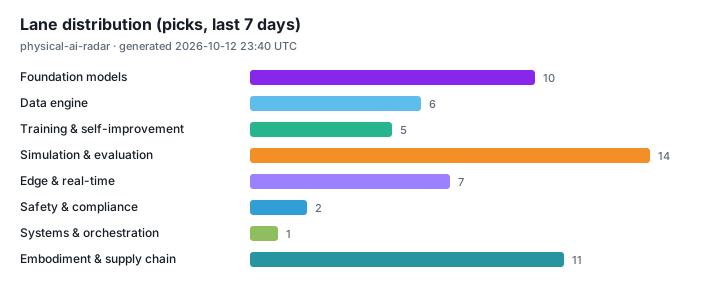
主线分布
| 主线 | # |
|---|---|
| 基座模型(VLA / WAM) | 8 |
| 数据引擎(采集 / 清洗 / scaling) | 6 |
| 训练与自我改进(RL / 后训练) | 3 |
| 仿真与评测(sim2real / 闭环) | 5 |
| 边缘与实时性(端侧推理 / 控制频率) | 7 |
| 安全、权限与合规 | 5 |
| 系统与编排(长程 / 多策略) | 2 |
| 本体与供应链(硬件 / 成本) | 1 |
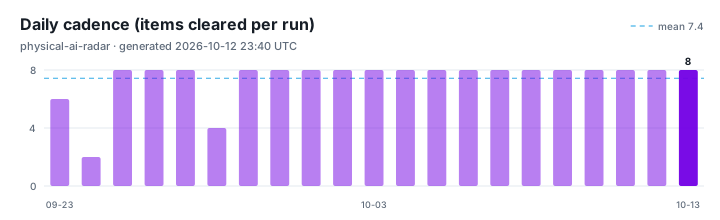
近期节奏

合规与标准观察
- ISO 25785-1 — Safety requirements for dynamically stable industrial mobile robots — Under development; committee-stage as of 2026-09.
- Regulation (EU) 2023/1230 (Machinery Regulation) — Fully applicable 2027-01-20.
- EU AI Act official timeline (Council of the EU) — High-risk deadlines 2027-12-02 / 2028-08-02 per Digital Omnibus.
本仓库为技术观察,不构成投资建议、产品承诺或安全认证结论。论文结论以作者自报为准。