Physical AI フロンティア・レーダー · 2026-09-19
フィジカルAIの最前線を毎日更新:8つの軸、三言語の要約、追跡可能な根拠。
- 生成時刻:
2026-09-19 08:12 UTC - 対象期間:
2026-09-16 → 2026-09-19 (UTC) - 根拠タグ:O = 一次情報 · R = 論文/プレプリント · M = メディア/二次情報
本日の注目
1. GeoAAC: Geometry-Based Adaptive Action Chunking from Denoising Trajectories in VLA Policies
- 軸: 基盤モデル(VLA / WAM) | 根拠:
[R]| 出典: arXiv 2609.20776v1 |2026-09-17 - 閉ループ成功率あり / 実機実験あり
- 重要な理由: 基盤モデル層の変化は下流タスクの出発点を変える:自社データの必要量と、機体間で転移できるかを左右する。
Action chunking is widely used for action generation and execution in Vision-Language-Action (VLA) policies, yet existing approaches commonly use a fixed action horizon.
2. rMuscle: Robotic Muscle Memory for Efficient Vision-Language-Action Model Inference
- 軸: エッジとリアルタイム(オンデバイス推論 / 制御周期) | 根拠:
[R]| 出典: arXiv 2609.19104v1 |2026-09-16 - 閉ループ成功率あり / 実機実験あり / 遅延・制御周期の数値あり
- 重要な理由: オンデバイスの遅延と制御周期は硬い制約:実時間予算を超えるモデルは制御ループに入れない。
Factory work is a promising early scenario for embodied AI: assigning repetitive manual jobs to robots has clear economic payoff, and a structured station keeps the jobs tractable for current policies.
3. PASSAGE: Scaling Scene-Aligned Motion Learning for Perceptive Humanoid Traversal in Cluttered Environments
- 軸: エッジとリアルタイム(オンデバイス推論 / 制御周期) | 根拠:
[R]| 出典: arXiv 2609.18732v1 |2026-09-16 - 主要数値:
50 Hz·48.1%·68.9%·70.3% - 定量結果あり / 閉ループ成功率あり / 遅延・制御周期の数値あり
- 重要な理由: オンデバイスの遅延と制御周期は硬い制約:実時間予算を超えるモデルは制御ループに入れない。
Humanoid robots can step over, squeeze past, and duck under obstacles, but learning to select and coordinate these behaviors from onboard perception remains challenging.
4. StageGuard: Learning Stage Transitions for Long-Horizon Robot Tasks via Agentic Distillation
- 軸: システムとオーケストレーション(長期タスク / 複数方策) | 根拠:
[R]| 出典: arXiv 2609.20791v1 |2026-09-17 - 閉ループ成功率あり / 実機実験あり / 遅延・制御周期の数値あり
- 重要な理由: 長期タスクのシステム形態はオーケストレーターと方策プールであり、運用対象は単一モデルから能力境界の集合になる。
Hierarchical planning frameworks combine skills from multiple robot control policies for long-horizon task execution, where determining when to terminate the current skill and advance to the next subtask is essential.
5. Agile-WAM: An Agile Tactile World Action Model for Contact-Rich Robot Control
- 軸: 基盤モデル(VLA / WAM) | 根拠:
[R]| 出典: arXiv 2609.20761v1 |2026-09-17 - 主要数値:
11.9 ms - 定量結果あり / 閉ループ成功率あり / 実機実験あり / 遅延・制御周期の数値あり
- 重要な理由: 基盤モデル層の変化は下流タスクの出発点を変える:自社データの必要量と、機体間で転移できるかを左右する。
World Action Models (WAMs) advance beyond conventional visuomotor policies by jointly predicting future world states and robot actions, enabling the policy to learn physical dynamics that support effective control.
6. Robots Are Learning to Feel
- 軸: データエンジン(収集 / 精査 / スケーリング) | 根拠:
[M]| 出典: IEEE Spectrum Robotics |2026-09-10 - 主要数値:
100 hours·12 tasks·3,000 hours·30,000 hours - 定量結果あり / 閉ループ成功率あり / 実機実験あり / 遅延・制御周期の数値あり
- 重要な理由: データの取得元と精査パイプラインが現在の真の堀であり、新規タスク単価を決める。
Dexterous manipulation remains one of the biggest barriers keeping robots from successfully tackling a wide range of everyday tasks.
7. FIVE-VLA: Fast and EffectIVE Autonomous Driving with Recurrent Action Memory
- 軸: シミュレーションと評価(sim2real / 閉ループ) | 根拠:
[R]| 出典: arXiv 2609.18623v1 |2026-09-16 - 主要数値:
641M parameters·10%·10.2%·7.7% - 定量結果あり / 閉ループ成功率あり / 実機実験あり
- 重要な理由: 評価手法が出荷判断を決める:オフライン指標は閉ループ成功率ではなく、評価予算は人手からGPU時間へ移りつつある。
State-of-the-art vision-language-action models (VLA) for autonomous driving face critical limitations: excessive parameter counts, inefficient high-resolution image processing, and lack of temporal memory.
8. Towards High-DoF Dexterous Manipulation through VLA Post-Training
- 軸: 学習と自己改善(RL / 事後学習) | 根拠:
[R]| 出典: arXiv 2609.19666v1 |2026-09-17 - 実機実験あり / コードまたは重み公開
- 重要な理由: 事後学習と自己改善は、配備後も方策が強くなれるか、運用で介入データを取る必要があるかを決める。
Imitation-learned vision–language–action (VLA) foundation models acquire broad manipulation capabilities by scaling robot data across tasks and embodiments, but reliable deployment on a specific downstream task and hardware platform…
フロンティア基準(キュレーション)
1. RoboWorld: fast and reliable neural simulators for generalist robot policy evaluation
- 軸: シミュレーションと評価(sim2real / 閉ループ) | 根拠:
[R]| 出典: arXiv 2607.01060 |2026 - 主要数値:
closed-loop rollouts in a video world model·VLM judge·rankings strongly correlated with real-world eval - 重要な理由: 世界モデル内の順位が実機の順位と一致すれば、評価予算は人手からGPU時間へ移る。ただし実機の抜き取り検査は省けない。
2. NVIDIA Jetson Thor: up to 2070 FP4 TFLOPS and 128 GB at 40-130 W
- 軸: エッジとリアルタイム(オンデバイス推論 / 制御周期) | 根拠:
[O]| 出典: NVIDIA |2026 - 主要数値:
7.5x AI compute vs Orin·3.5x energy efficiency vs AGX Orin·Jetson T2000: 400 FP4 TFLOPS / 16 GB - 定量結果あり / 遅延・制御周期の数値あり
- 重要な理由: オンデバイス計算の世代交代が世界モデルと推論時計算の余地を生むが、実時間予算は個別に実測が必要。
3. LeRobotDataset v3.0: a standardised, streamable format for robot learning data
- 軸: データエンジン(収集 / 精査 / スケーリング) | 根拠:
[O]| 出典: Hugging Face |2026 - 主要数値:
Parquet + MP4 + relational metadata·multi-episode packing·native streaming for multi-TB datasets - 重要な理由: フォーマットはデータがLeRobot v3、アセットがOpenUSDへ収束。ワンステップで変換できるデータは、私有形式に閉じた同時間のデータより価値が高い。
4. π*0.6 / Recap: a VLA that learns from experience via advantage-conditioned policies
- 軸: 基盤モデル(VLA / WAM) | 根拠:
[R]| 出典: arXiv 2511.14759 |2026 - 主要数値:
RL from autonomous rollouts + human corrections·value function fine-tuned on online data - 重要な理由: 「配備=学習」の方法論的基盤。利用するには、介入ログと成功判定を一級のデータにする運用が前提。
5. XPENG commissions its humanoid production lines; IRON walks off the line autonomously
- 軸: ハードウェアとサプライチェーン(機体 / コスト) | 根拠:
[O]| 出典: PR Newswire |2026-09-08 - 主要数値:
>80% of core processes automated (reported)·target 1,000+ units/month by year-end (reported) - 重要な理由: 産線稼働は検証可能な事実、月産目標は報道ベース。両者を分けて引用することが、今期最も指摘されやすい論点。
6. The reliability gap: industrial buyers want 95-99% uptime; most humanoids run 30-90 minutes
- 軸: 安全・権限・コンプライアンス | 根拠:
[M]| 出典: robozaps / industry analyses |2026 - 主要数値:
95-99% expected uptime·30-90 min continuous operation·MTBI and autonomy rate are the metrics that matter - 重要な理由: 2027年の律速は恐らくモデル性能ではなく、介入間平均時間と認証の空白期間である。
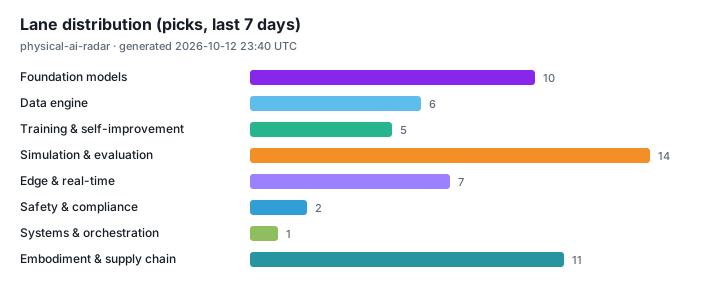
軸ごとの分布
| 軸 | # |
|---|---|
| 基盤モデル(VLA / WAM) | 8 |
| データエンジン(収集 / 精査 / スケーリング) | 6 |
| 学習と自己改善(RL / 事後学習) | 3 |
| シミュレーションと評価(sim2real / 閉ループ) | 5 |
| エッジとリアルタイム(オンデバイス推論 / 制御周期) | 7 |
| 安全・権限・コンプライアンス | 5 |
| システムとオーケストレーション(長期タスク / 複数方策) | 2 |
| ハードウェアとサプライチェーン(機体 / コスト) | 1 |
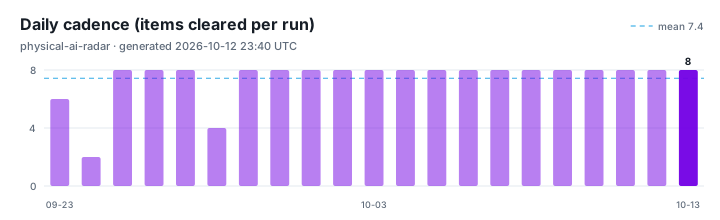
直近の推移

標準・規制ウォッチ
- ISO 25785-1 — Safety requirements for dynamically stable industrial mobile robots — Under development; committee-stage as of 2026-09.
- Regulation (EU) 2023/1230 (Machinery Regulation) — Fully applicable 2027-01-20.
- EU AI Act official timeline (Council of the EU) — High-risk deadlines 2027-12-02 / 2028-08-02 per Digital Omnibus.
本リポジトリは技術観察であり、投資助言・製品保証・安全認証の結論ではありません。論文の主張は著者による自己報告です。