Physical AI Radar · 2026-09-19
A daily radar on the Physical AI frontier: eight lanes, trilingual digests, traceable evidence.
- Generated:
2026-09-19 08:12 UTC - Window:
2026-09-16 → 2026-09-19 (UTC) - Evidence tags: O = first-party official · R = paper/preprint · M = media/secondary
Today’s picks
1. GeoAAC: Geometry-Based Adaptive Action Chunking from Denoising Trajectories in VLA Policies
- Lane: Foundation models (VLA / WAM) | Evidence:
[R]| Source: arXiv 2609.20776v1 |2026-09-17 - closed-loop success reported / real-robot experiments
- Why it matters: Changes at the foundation-model layer reset the starting point for every downstream task: how much of your own data you need, and whether it transfers across embodiments.
Action chunking is widely used for action generation and execution in Vision-Language-Action (VLA) policies, yet existing approaches commonly use a fixed action horizon.
2. rMuscle: Robotic Muscle Memory for Efficient Vision-Language-Action Model Inference
- Lane: Edge & real-time (on-device inference / control rate) | Evidence:
[R]| Source: arXiv 2609.19104v1 |2026-09-16 - closed-loop success reported / real-robot experiments / latency or control-rate numbers
- Why it matters: On-device latency and control rate are hard constraints: however capable the model, it cannot enter the control loop if it misses the real-time budget.
Factory work is a promising early scenario for embodied AI: assigning repetitive manual jobs to robots has clear economic payoff, and a structured station keeps the jobs tractable for current policies.
3. PASSAGE: Scaling Scene-Aligned Motion Learning for Perceptive Humanoid Traversal in Cluttered Environments
- Lane: Edge & real-time (on-device inference / control rate) | Evidence:
[R]| Source: arXiv 2609.18732v1 |2026-09-16 - Key numbers:
50 Hz·48.1%·68.9%·70.3% - quantitative results / closed-loop success reported / latency or control-rate numbers
- Why it matters: On-device latency and control rate are hard constraints: however capable the model, it cannot enter the control loop if it misses the real-time budget.
Humanoid robots can step over, squeeze past, and duck under obstacles, but learning to select and coordinate these behaviors from onboard perception remains challenging.
4. StageGuard: Learning Stage Transitions for Long-Horizon Robot Tasks via Agentic Distillation
- Lane: Systems & orchestration (long-horizon / multi-policy) | Evidence:
[R]| Source: arXiv 2609.20791v1 |2026-09-17 - closed-loop success reported / real-robot experiments / latency or control-rate numbers
- Why it matters: Long-horizon systems look like an orchestrator plus a policy pool; the operated object becomes a set of capability boundaries rather than one model.
Hierarchical planning frameworks combine skills from multiple robot control policies for long-horizon task execution, where determining when to terminate the current skill and advance to the next subtask is essential.
5. Agile-WAM: An Agile Tactile World Action Model for Contact-Rich Robot Control
- Lane: Foundation models (VLA / WAM) | Evidence:
[R]| Source: arXiv 2609.20761v1 |2026-09-17 - Key numbers:
11.9 ms - quantitative results / closed-loop success reported / real-robot experiments / latency or control-rate numbers
- Why it matters: Changes at the foundation-model layer reset the starting point for every downstream task: how much of your own data you need, and whether it transfers across embodiments.
World Action Models (WAMs) advance beyond conventional visuomotor policies by jointly predicting future world states and robot actions, enabling the policy to learn physical dynamics that support effective control.
6. Robots Are Learning to Feel
- Lane: Data engine (collection / curation / scaling) | Evidence:
[M]| Source: IEEE Spectrum Robotics |2026-09-10 - Key numbers:
100 hours·12 tasks·3,000 hours·30,000 hours - quantitative results / closed-loop success reported / real-robot experiments / latency or control-rate numbers
- Why it matters: Data sourcing and curation pipelines are the real moat today; they set the cost per new task.
Dexterous manipulation remains one of the biggest barriers keeping robots from successfully tackling a wide range of everyday tasks.
7. FIVE-VLA: Fast and EffectIVE Autonomous Driving with Recurrent Action Memory
- Lane: Simulation & evaluation (sim2real / closed-loop) | Evidence:
[R]| Source: arXiv 2609.18623v1 |2026-09-16 - Key numbers:
641M parameters·10%·10.2%·7.7% - quantitative results / closed-loop success reported / real-robot experiments
- Why it matters: Evaluation method decides what you dare to ship: offline metrics are not closed-loop success, and the evaluation budget is shifting from human hours to GPU hours.
State-of-the-art vision-language-action models (VLA) for autonomous driving face critical limitations: excessive parameter counts, inefficient high-resolution image processing, and lack of temporal memory.
8. Towards High-DoF Dexterous Manipulation through VLA Post-Training
- Lane: Training & self-improvement (RL / post-training) | Evidence:
[R]| Source: arXiv 2609.19666v1 |2026-09-17 - real-robot experiments / open code or weights
- Why it matters: Post-training and self-improvement decide whether a policy keeps getting better after deployment, and whether operations must capture intervention data.
Imitation-learned vision–language–action (VLA) foundation models acquire broad manipulation capabilities by scaling robot data across tasks and embodiments, but reliable deployment on a specific downstream task and hardware platform…
Frontier baseline (curated)
1. RoboWorld: fast and reliable neural simulators for generalist robot policy evaluation
- Lane: Simulation & evaluation (sim2real / closed-loop) | Evidence:
[R]| Source: arXiv 2607.01060 |2026 - Key numbers:
closed-loop rollouts in a video world model·VLM judge·rankings strongly correlated with real-world eval - Why it matters: If rankings inside a world model align with real-robot rankings, the evaluation budget shifts from human hours to GPU hours - real-robot spot checks still cannot be dropped.
2. NVIDIA Jetson Thor: up to 2070 FP4 TFLOPS and 128 GB at 40-130 W
- Lane: Edge & real-time (on-device inference / control rate) | Evidence:
[O]| Source: NVIDIA |2026 - Key numbers:
7.5x AI compute vs Orin·3.5x energy efficiency vs AGX Orin·Jetson T2000: 400 FP4 TFLOPS / 16 GB - quantitative results / latency or control-rate numbers
- Why it matters: A generational jump in on-device compute creates room for world models and test-time compute, yet the real-time budget still has to be measured item by item.
3. LeRobotDataset v3.0: a standardised, streamable format for robot learning data
- Lane: Data engine (collection / curation / scaling) | Evidence:
[O]| Source: Hugging Face |2026 - Key numbers:
Parquet + MP4 + relational metadata·multi-episode packing·native streaming for multi-TB datasets - Why it matters: The format question is converging on LeRobot v3 for data and OpenUSD for assets; data you can convert in one step is worth far more than the same hours locked in a private format.
4. π*0.6 / Recap: a VLA that learns from experience via advantage-conditioned policies
- Lane: Foundation models (VLA / WAM) | Evidence:
[R]| Source: arXiv 2511.14759 |2026 - Key numbers:
RL from autonomous rollouts + human corrections·value function fine-tuned on online data - Why it matters: The methodological basis for ‘deployment is training’: to use it, operations must first make intervention logs and success judgements first-class data.
5. XPENG commissions its humanoid production lines; IRON walks off the line autonomously
- Lane: Embodiment & supply chain (hardware / cost) | Evidence:
[O]| Source: PR Newswire |2026-09-08 - Key numbers:
>80% of core processes automated (reported)·target 1,000+ units/month by year-end (reported) - Why it matters: Line commissioning is a verifiable fact; the monthly target is reported second-hand. Separating the two is the easiest citation mistake to get caught on this cycle.
6. The reliability gap: industrial buyers want 95-99% uptime; most humanoids run 30-90 minutes
- Lane: Safety, authority & compliance | Evidence:
[M]| Source: robozaps / industry analyses |2026 - Key numbers:
95-99% expected uptime·30-90 min continuous operation·MTBI and autonomy rate are the metrics that matter - Why it matters: The 2027 rate limiter is unlikely to be model capability; it is mean time between interventions plus the certification gap.
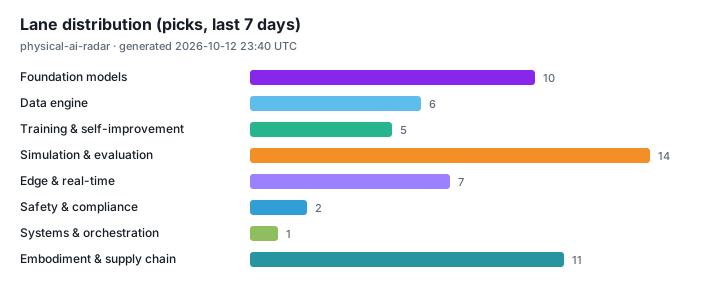
Lane distribution
| Lane | # |
|---|---|
| Foundation models (VLA / WAM) | 8 |
| Data engine (collection / curation / scaling) | 6 |
| Training & self-improvement (RL / post-training) | 3 |
| Simulation & evaluation (sim2real / closed-loop) | 5 |
| Edge & real-time (on-device inference / control rate) | 7 |
| Safety, authority & compliance | 5 |
| Systems & orchestration (long-horizon / multi-policy) | 2 |
| Embodiment & supply chain (hardware / cost) | 1 |
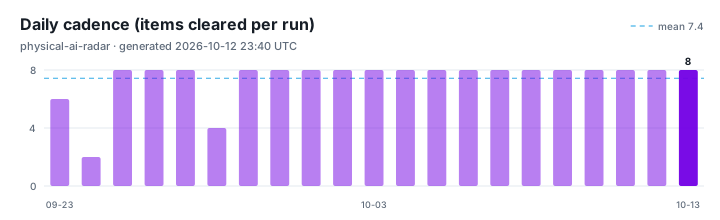
Recent cadence

Standards & compliance watch
- ISO 25785-1 — Safety requirements for dynamically stable industrial mobile robots — Under development; committee-stage as of 2026-09.
- Regulation (EU) 2023/1230 (Machinery Regulation) — Fully applicable 2027-01-20.
- EU AI Act official timeline (Council of the EU) — High-risk deadlines 2027-12-02 / 2028-08-02 per Digital Omnibus.
This repository is technical observation. It is not investment advice, a product commitment, or a safety certification conclusion. Paper claims are author-reported.