Physical AI Radar · 2026-09-24
A daily radar on the Physical AI frontier: eight lanes, trilingual digests, traceable evidence.
- Generated:
2026-09-24 01:40 UTC - Window:
2026-09-21 → 2026-09-24 (UTC) - Evidence tags: O = first-party official · R = paper/preprint · M = media/secondary
Today’s picks
1. At AI Day Singapore, NVIDIA and Partners Showcase AI Advancements Across Southeast Asia
- Lane: Training & self-improvement (RL / post-training) | Evidence:
[O]| Source: NVIDIA Blog |2026-09-23 - Why it matters: Post-training and self-improvement decide whether a policy keeps getting better after deployment, and whether operations must capture intervention data.
NVIDIA AI Day Singapore, which takes place Sept. 22-23 at the Raffles City Convention Centre, is offering attendees opportunities to explore the hands-on training, expert-led sessions and advanced tools to accelerate their work in AI and…
2. How to Use NVIDIA Warp and MjWarp to Accelerate Robotics Simulation and Learning Workflows
- Lane: Simulation & evaluation (sim2real / closed-loop) | Evidence:
[O]| Source: Hugging Face Blog |2026-09-23 - Why it matters: Evaluation method decides what you dare to ship: offline metrics are not closed-loop success, and the evaluation budget is shifting from human hours to GPU hours.
Frontier baseline (curated)
1. RoboTTT: context scaling for robot policies via test-time training
- Lane: Edge & real-time (on-device inference / control rate) | Evidence:
[R]| Source: arXiv 2607.15275 (NVIDIA) |2026-07-16 - Key numbers:
8K timestep visuomotor context·3 orders of magnitude beyond prior policies·no inference-latency growth - latency or control-rate numbers
- Why it matters: Long context enters the policy without added latency, so one-shot in-context imitation and on-the-fly improvement can live in the same inference pass.
2. Newton: open-source GPU physics engine for robotics (NVIDIA, Google DeepMind, Disney Research)
- Lane: Simulation & evaluation (sim2real / closed-loop) | Evidence:
[O]| Source: NVIDIA Developer |2026 - Key numbers:
built on Warp + OpenUSD·MuJoCo Warp up to 152x (locomotion) / 313x (manipulation) vs MJX on RTX 4090 - open code or weights
- Why it matters: A differentiable new simulation base plus Isaac Lab’s multi-backend switching lets training and evaluation reuse one actuator configuration.
3. GR00T N1.7: open reasoning VLA model for humanoid robots
- Lane: Foundation models (VLA / WAM) | Evidence:
[O]| Source: NVIDIA / Hugging Face |2026 - Key numbers:
3B parameters·open weights - latency or control-rate numbers
- Why it matters: A 3B open reasoning VLA gives in-house teams a fine-tunable, deployable starting point instead of building a foundation model.
4. HumanEgo: zero-shot robot learning from minutes of human egocentric video
- Lane: Data engine (collection / curation / scaling) | Evidence:
[R]| Source: arXiv 2605.24934 |2026 - Key numbers:
30 min/task -> 92.5% average success on 4 real tasks·15 min -> 75%·+41% over matched-time teleoperation - Why it matters: It pushes the cost per new task down to minutes of data - the most direct yardstick for whether your data strategy is behind.
5. Regulation (EU) 2023/1230 becomes fully applicable
- Lane: Safety, authority & compliance | Evidence:
[O]| Source: EUR-Lex / TUV SUD |2027-01-20 - Key numbers:
fully applicable 2027-01-20·replaces Directive 2006/42/EC - Why it matters: A hard date you can copy into a project plan: after it, non-compliant machinery cannot be placed on the EU market.
6. PL-CBF: finite-horizon safety at runtime via parallel fallback rollouts
- Lane: Safety, authority & compliance | Evidence:
[R]| Source: arXiv 2605.16588 |2026 - Key numbers:
library of fallback policies·least-invasive safe mode·QP minimally modifies the nominal policy - Why it matters: ‘Least-invasive fallback’ can go straight into customer acceptance criteria - far more concrete than ‘we are safe’.
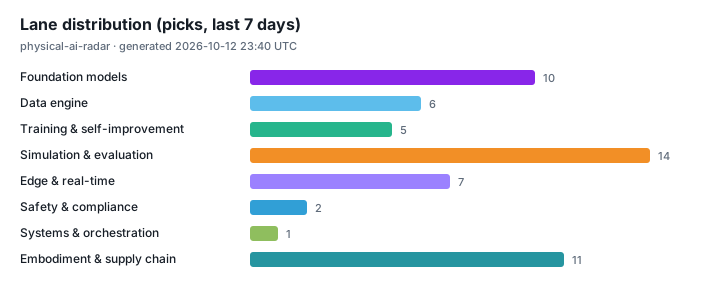
Lane distribution
| Lane | # |
|---|---|
| Foundation models (VLA / WAM) | 3 |
| Data engine (collection / curation / scaling) | 5 |
| Training & self-improvement (RL / post-training) | 5 |
| Simulation & evaluation (sim2real / closed-loop) | 5 |
| Edge & real-time (on-device inference / control rate) | 5 |
| Safety, authority & compliance | 5 |
| Systems & orchestration (long-horizon / multi-policy) | 1 |
| Embodiment & supply chain (hardware / cost) | 2 |
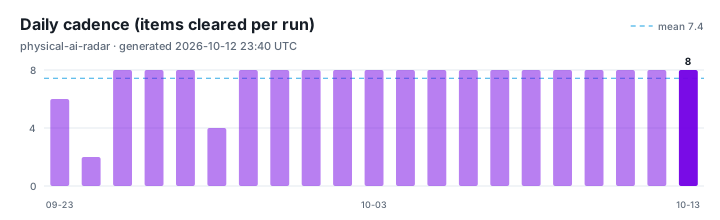
Recent cadence

Standards & compliance watch
- ISO 25785-1 — Safety requirements for dynamically stable industrial mobile robots — Under development; committee-stage as of 2026-09.
- Regulation (EU) 2023/1230 (Machinery Regulation) — Fully applicable 2027-01-20.
- EU AI Act official timeline (Council of the EU) — High-risk deadlines 2027-12-02 / 2028-08-02 per Digital Omnibus.
This repository is technical observation. It is not investment advice, a product commitment, or a safety certification conclusion. Paper claims are author-reported.