Physical AI Radar · 2026-09-23
A daily radar on the Physical AI frontier: eight lanes, trilingual digests, traceable evidence.
- Generated:
2026-09-23 01:40 UTC - Window:
2026-09-20 → 2026-09-23 (UTC) - Evidence tags: O = first-party official · R = paper/preprint · M = media/secondary
Today’s picks
1. NVIDIA Isaac ROS 5.0 Advances Agentic, Open Source Robotics Development
- Lane: Systems & orchestration (long-horizon / multi-policy) | Evidence:
[O]| Source: NVIDIA Blog |2026-09-22 - open code or weights
- Why it matters: Long-horizon systems look like an orchestrator plus a policy pool; the operated object becomes a set of capability boundaries rather than one model.
To build and deploy sophisticated robotics applications that can perceive, reason and act in dynamic environments, developers need new physical AI models and tools.
2. How UK AISI and EvalEval Are Making Benchmark Results Reproducible
- Lane: Simulation & evaluation (sim2real / closed-loop) | Evidence:
[O]| Source: Hugging Face Blog |2026-09-22 - Why it matters: Evaluation method decides what you dare to ship: offline metrics are not closed-loop success, and the evaluation budget is shifting from human hours to GPU hours.
3. Jun Kim, oMLX creator and maintainer, joins Hugging Face to support the MLX community
- Lane: Training & self-improvement (RL / post-training) | Evidence:
[O]| Source: Hugging Face Blog |2026-09-22 - Why it matters: Post-training and self-improvement decide whether a policy keeps getting better after deployment, and whether operations must capture intervention data.
4. Barbara Mazzolai Wants to Build a New Field of Robotics
- Lane: Edge & real-time (on-device inference / control rate) | Evidence:
[M]| Source: IEEE Spectrum Robotics |2026-09-22 - latency or control-rate numbers
- Why it matters: On-device latency and control rate are hard constraints: however capable the model, it cannot enter the control loop if it misses the real-time budget.
Throughout her career, roboticist Barbara Mazzolai has turned to nature for inspiration. Now she wants to ensure the technology she builds gives back to the environment, too.
5. NeoMME: an efficient Multimodal-native and Multilingual Encoder
- Lane: Embodiment & supply chain (hardware / cost) | Evidence:
[O]| Source: Hugging Face Blog |2026-09-03 - Why it matters: Embodiment and supply chain set the cost curve and delivery cadence; actuators remain the dominant share of BOM.
6. This Robot Will Draw Your Blood Now
- Lane: Edge & real-time (on-device inference / control rate) | Evidence:
[M]| Source: IEEE Spectrum Robotics |2026-09-07 - quantitative results / latency or control-rate numbers
- Why it matters: On-device latency and control rate are hard constraints: however capable the model, it cannot enter the control loop if it misses the real-time budget.
You sit down and put your arm in the cradle. You press a button.
Frontier baseline (curated)
1. SHIELD: safety on humanoids via control barrier functions in expectation on learned dynamics
- Lane: Safety, authority & compliance | Evidence:
[R]| Source: arXiv 2505.11494 |2026 - Key numbers:
runtime constraint specification·no retraining when constraints change - Why it matters: Makes ‘change the constraint without retraining’ possible - the academic counterpart of a local authority gate.
2. Gemini Robotics 2 brings whole body intelligence to robots
- Lane: Foundation models (VLA / WAM) | Evidence:
[O]| Source: Google DeepMind |2026 - Key numbers:
full humanoid control, feet to fingertips·bi-arm robots - latency or control-rate numbers
- Why it matters: Whole-body control enters the generalist VLA feature list, so upper-body manipulation and lower-body balance stop living in two separate systems.
3. NVIDIA Jetson Thor: up to 2070 FP4 TFLOPS and 128 GB at 40-130 W
- Lane: Edge & real-time (on-device inference / control rate) | Evidence:
[O]| Source: NVIDIA |2026 - Key numbers:
7.5x AI compute vs Orin·3.5x energy efficiency vs AGX Orin·Jetson T2000: 400 FP4 TFLOPS / 16 GB - quantitative results / latency or control-rate numbers
- Why it matters: A generational jump in on-device compute creates room for world models and test-time compute, yet the real-time budget still has to be measured item by item.
4. Bringing a frontier world model to the convenience store: Telexistence’s DreamZero experiment on AWS
- Lane: Simulation & evaluation (sim2real / closed-loop) | Evidence:
[O]| Source: AWS Physical AI Blog |2026-09-09 - Key numbers:
14B world action model·best closed-loop 45%·real-data-trained run 0% in sim·MSE -55.6% from 1k to 2k steps·~583 ms/step on 8xB200·curation flagged 39.3% vs human 49.7% - Why it matters: Turns ‘is a frontier model right for my robot’ into measured numbers, and honestly records the 0% when real data was evaluated in sim - the domain-gap diagnosis is itself the deliverable.
5. Post-train NVIDIA Cosmos 3 Edge for on-device robot control
- Lane: Edge & real-time (on-device inference / control rate) | Evidence:
[O]| Source: NVIDIA Technical Blog |2026-08 - Key numbers:
4B omni-model·2B Nemotron reasoner·runs on Jetson Thor·receding-horizon control loop - closed-loop success reported / open code or weights
- Why it matters: The first reproducible path for a world model on-device: post-train, serve on Thor, then evaluate closed-loop, with code and checkpoint released.
6. Egocentric human video can outperform real-robot data for embodied pretraining
- Lane: Data engine (collection / curation / scaling) | Evidence:
[R]| Source: arXiv 2606.20521 |2026 - Key numbers:
-24% validation loss at equal data·+52.5% in-distribution success·+90% out-of-distribution success - latency or control-rate numbers
- Why it matters: Teams without a fleet can still build a data advantage; teams with a fleet but no curation and judging pipeline hold data that is only a storage cost.
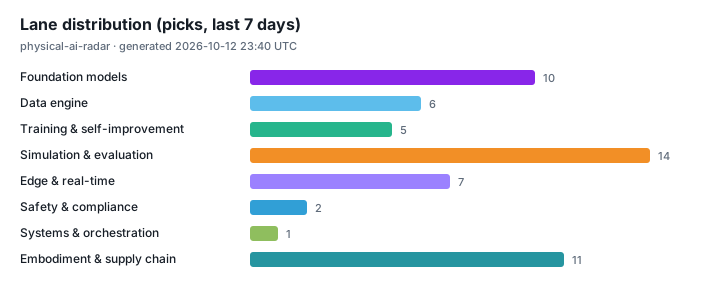
Lane distribution
| Lane | # |
|---|---|
| Foundation models (VLA / WAM) | 3 |
| Data engine (collection / curation / scaling) | 5 |
| Training & self-improvement (RL / post-training) | 5 |
| Simulation & evaluation (sim2real / closed-loop) | 5 |
| Edge & real-time (on-device inference / control rate) | 7 |
| Safety, authority & compliance | 5 |
| Systems & orchestration (long-horizon / multi-policy) | 2 |
| Embodiment & supply chain (hardware / cost) | 3 |
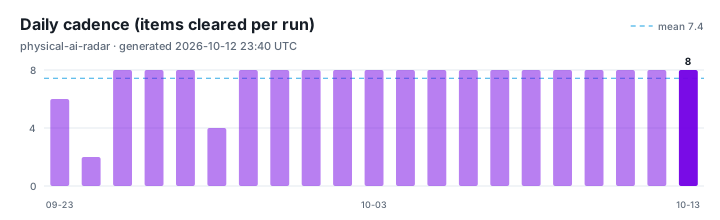
Recent cadence

Standards & compliance watch
- ISO 25785-1 — Safety requirements for dynamically stable industrial mobile robots — Under development; committee-stage as of 2026-09.
- Regulation (EU) 2023/1230 (Machinery Regulation) — Fully applicable 2027-01-20.
- EU AI Act official timeline (Council of the EU) — High-risk deadlines 2027-12-02 / 2028-08-02 per Digital Omnibus.
This repository is technical observation. It is not investment advice, a product commitment, or a safety certification conclusion. Paper claims are author-reported.