Physical AI Radar · 2026-09-22
A daily radar on the Physical AI frontier: eight lanes, trilingual digests, traceable evidence.
- Generated:
2026-09-22 01:40 UTC - Window:
2026-09-19 → 2026-09-22 (UTC) - Evidence tags: O = first-party official · R = paper/preprint · M = media/secondary
Today’s picks
1. Why Deploying Physical AI at Scale Demands Safety at Every Layer
- Lane: Safety, authority & compliance | Evidence:
[O]| Source: NVIDIA Blog |2026-09-21 - real-robot experiments
- Why it matters: Until dedicated standards land, safety rests on architecture and runtime guarantees; this layer gates access to customer sites.
Physical AI is moving rapidly from research to large-scale deployment. By 2035, ABI Research projects an installed base of 49 million level 3-5 autonomous vehicles (AVs), while Omdia estimates that roughly 60 million industrial robots…
2. Cyborg Roaches Can Stab You With Needles
- Lane: Edge & real-time (on-device inference / control rate) | Evidence:
[M]| Source: IEEE Spectrum Robotics |2026-09-05 - quantitative results / open code or weights / latency or control-rate numbers
- Why it matters: On-device latency and control rate are hard constraints: however capable the model, it cannot enter the control loop if it misses the real-time budget.
Imagine you are trapped under rubble after an earthquake and you see an electronics-covered cockroach with a spring-loaded needle on its back scuttling toward you.
3. Video Friday: Humanoid Robot Takes On Monkey Bars
- Lane: Training & self-improvement (RL / post-training) | Evidence:
[M]| Source: IEEE Spectrum Robotics |2026-09-11 - open code or weights / latency or control-rate numbers
- Why it matters: Post-training and self-improvement decide whether a policy keeps getting better after deployment, and whether operations must capture intervention data.
Video Friday is your weekly selection of awesome robotics videos, collected by your friends at IEEE Spectrum robotics.
4. Boots on the Ground: ‘WARDOGS’ Goes All Out on GeForce NOW at Early-Access Launch
- Lane: Simulation & evaluation (sim2real / closed-loop) | Evidence:
[O]| Source: NVIDIA Blog |2026-09-10 - Why it matters: Evaluation method decides what you dare to ship: offline metrics are not closed-loop success, and the evaluation budget is shifting from human hours to GPU hours.
Gear up: The latest PC games and major updates are ready to play on GeForce NOW this week. WARDOGS drops onto the cloud at early-access launch, alongside the Valheim 1.0 Deep North update and Bus Simulator 27 — part of nine new titles…
5. Skild AI Taps NVIDIA Physical AI to Teach Robots New Tasks From a Single Video
- Lane: Data engine (collection / curation / scaling) | Evidence:
[O]| Source: NVIDIA Blog |2026-09-10 - Why it matters: Data sourcing and curation pipelines are the real moat today; they set the cost per new task.
Manufacturing floors, warehouses and production lines rarely stay fixed — tasks change, layouts shift and new products arrive, and most robots can’t keep up without significant reprogramming.
6. BenchMIRT: What are LLM benchmarks actually measuring?
- Lane: Simulation & evaluation (sim2real / closed-loop) | Evidence:
[O]| Source: Hugging Face Blog |2026-09-01 - Why it matters: Evaluation method decides what you dare to ship: offline metrics are not closed-loop success, and the evaluation budget is shifting from human hours to GPU hours.
7. Give Your Coding Agents a Memory You Own
- Lane: Systems & orchestration (long-horizon / multi-policy) | Evidence:
[O]| Source: Hugging Face Blog |2026-09-03 - Why it matters: Long-horizon systems look like an orchestrator plus a policy pool; the operated object becomes a set of capability boundaries rather than one model.
8. Async GRPO with LoRA across HF Jobs: a bucket, a proxy, and no NCCL
- Lane: Training & self-improvement (RL / post-training) | Evidence:
[O]| Source: Hugging Face Blog |2026-09-10 - Why it matters: Post-training and self-improvement decide whether a policy keeps getting better after deployment, and whether operations must capture intervention data.
Frontier baseline (curated)
1. ISO 25785-1 (under development): safety for dynamically stable industrial mobile robots
- Lane: Safety, authority & compliance | Evidence:
[O]| Source: ISO |2026 - Key numbers:
committee stage as of 2026-09·covers legged / self-balancing robots - Why it matters: Humanoids break the fixed-base premise of ISO 10218; until the dedicated standard lands, safety rests on architecture and runtime guarantees.
2. NVIDIA Jetson Thor: up to 2070 FP4 TFLOPS and 128 GB at 40-130 W
- Lane: Edge & real-time (on-device inference / control rate) | Evidence:
[O]| Source: NVIDIA |2026 - Key numbers:
7.5x AI compute vs Orin·3.5x energy efficiency vs AGX Orin·Jetson T2000: 400 FP4 TFLOPS / 16 GB - quantitative results / latency or control-rate numbers
- Why it matters: A generational jump in on-device compute creates room for world models and test-time compute, yet the real-time budget still has to be measured item by item.
3. LeRobotDataset v3.0: a standardised, streamable format for robot learning data
- Lane: Data engine (collection / curation / scaling) | Evidence:
[O]| Source: Hugging Face |2026 - Key numbers:
Parquet + MP4 + relational metadata·multi-episode packing·native streaming for multi-TB datasets - Why it matters: The format question is converging on LeRobot v3 for data and OpenUSD for assets; data you can convert in one step is worth far more than the same hours locked in a private format.
4. Gemini Robotics 2 brings whole body intelligence to robots
- Lane: Foundation models (VLA / WAM) | Evidence:
[O]| Source: Google DeepMind |2026 - Key numbers:
full humanoid control, feet to fingertips·bi-arm robots - latency or control-rate numbers
- Why it matters: Whole-body control enters the generalist VLA feature list, so upper-body manipulation and lower-body balance stop living in two separate systems.
5. EgoScale: scaling dexterous manipulation with diverse egocentric human data
- Lane: Data engine (collection / curation / scaling) | Evidence:
[R]| Source: arXiv 2602.16710 |2026 - Key numbers:
44k hours of egocentric video·+54% average success vs no-pretraining on a 22-DoF hand·transfers to lower-DoF hands - Why it matters: Large-scale human motion is shown to be a reusable, embodiment-agnostic motor prior, so dexterous hands do not start from zero.
6. Egocentric human video can outperform real-robot data for embodied pretraining
- Lane: Data engine (collection / curation / scaling) | Evidence:
[R]| Source: arXiv 2606.20521 |2026 - Key numbers:
-24% validation loss at equal data·+52.5% in-distribution success·+90% out-of-distribution success - latency or control-rate numbers
- Why it matters: Teams without a fleet can still build a data advantage; teams with a fleet but no curation and judging pipeline hold data that is only a storage cost.
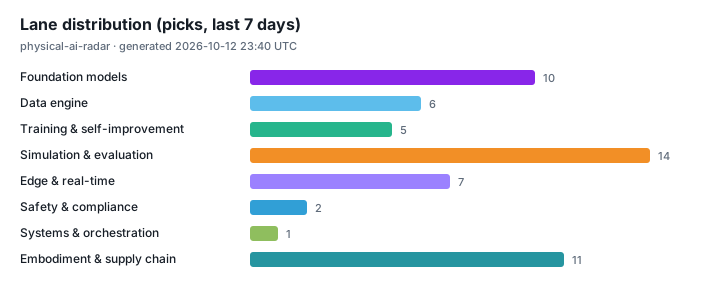
Lane distribution
| Lane | # |
|---|---|
| Foundation models (VLA / WAM) | 3 |
| Data engine (collection / curation / scaling) | 6 |
| Training & self-improvement (RL / post-training) | 6 |
| Simulation & evaluation (sim2real / closed-loop) | 6 |
| Edge & real-time (on-device inference / control rate) | 6 |
| Safety, authority & compliance | 6 |
| Systems & orchestration (long-horizon / multi-policy) | 2 |
| Embodiment & supply chain (hardware / cost) | 2 |
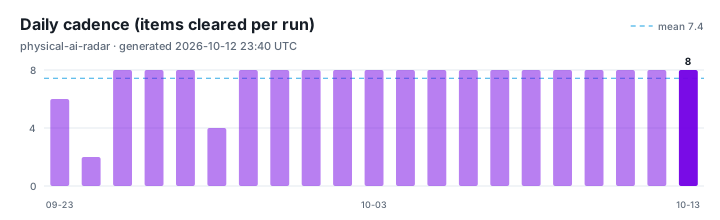
Recent cadence

Standards & compliance watch
- ISO 25785-1 — Safety requirements for dynamically stable industrial mobile robots — Under development; committee-stage as of 2026-09.
- Regulation (EU) 2023/1230 (Machinery Regulation) — Fully applicable 2027-01-20.
- EU AI Act official timeline (Council of the EU) — High-risk deadlines 2027-12-02 / 2028-08-02 per Digital Omnibus.
This repository is technical observation. It is not investment advice, a product commitment, or a safety certification conclusion. Paper claims are author-reported.