Physical AI Radar · 2026-09-21
A daily radar on the Physical AI frontier: eight lanes, trilingual digests, traceable evidence.
- Generated:
2026-09-21 01:40 UTC - Window:
2026-09-18 → 2026-09-21 (UTC) - Evidence tags: O = first-party official · R = paper/preprint · M = media/secondary
Today’s picks
1. Physical AI Takes the Wheel: How the World’s Robotaxi Leaders Are Building With NVIDIA Technologies
- Lane: Systems & orchestration (long-horizon / multi-policy) | Evidence:
[O]| Source: NVIDIA Blog |2026-09-10 - quantitative results
- Why it matters: Long-horizon systems look like an orchestrator plus a policy pool; the operated object becomes a set of capability boundaries rather than one model.
The global robotaxi market — physical AI’s first commercial breakthrough — is projected to reach $400 billion by 2035, with over 6 million commercial vehicles in operation as driverless fleets are already moving people through some of the…
2. Fine-tuning a 350M Model for Better Structured Outputs in 100 GRPO Steps
- Lane: Training & self-improvement (RL / post-training) | Evidence:
[O]| Source: Hugging Face Blog |2026-09-03 - Why it matters: Post-training and self-improvement decide whether a policy keeps getting better after deployment, and whether operations must capture intervention data.
3. NVIDIA Brings Real-Time AI to Broadcast, Sports and Global Streaming at IBC
- Lane: Edge & real-time (on-device inference / control rate) | Evidence:
[O]| Source: NVIDIA Blog |2026-09-09 - latency or control-rate numbers
- Why it matters: On-device latency and control rate are hard constraints: however capable the model, it cannot enter the control loop if it misses the real-time budget.
At the IBC conference, running Sept. 11-14 in Amsterdam, the creative, technology and business communities are coming together to turn ideas into action and discuss innovations across the media and entertainment industries.
4. Quantization-Aware Healing: a compressed, 4-bit model that outperforms its full-precision original
- Lane: Edge & real-time (on-device inference / control rate) | Evidence:
[O]| Source: Hugging Face Blog |2026-08-25 - latency or control-rate numbers
- Why it matters: On-device latency and control rate are hard constraints: however capable the model, it cannot enter the control loop if it misses the real-time budget.
5. The Best Way to Explore Lunar Craters Is a Giant Robot Ball
- Lane: Embodiment & supply chain (hardware / cost) | Evidence:
[M]| Source: IEEE Spectrum Robotics |2026-09-03 - latency or control-rate numbers
- Why it matters: Embodiment and supply chain set the cost curve and delivery cadence; actuators remain the dominant share of BOM.
On a good day, the rock quarry in central Texas is about 370,000 kilometers (230,000 miles) from the moon. But last February, when Rishi Jangale watched his 1.8-meter-wide, 150-kilogram inflatable robot roll effortlessly over rocks,…
6. Piloting the world’s first double-blind AI evaluations
- Lane: Simulation & evaluation (sim2real / closed-loop) | Evidence:
[O]| Source: Google DeepMind |2026-08-27 - Why it matters: Evaluation method decides what you dare to ship: offline metrics are not closed-loop success, and the evaluation budget is shifting from human hours to GPU hours.
Piloting the world’s first double-blind AI evaluations
7. How to Train a Cross-Embodiment Robot Navigation Policy with AI Agents
- Lane: Data engine (collection / curation / scaling) | Evidence:
[O]| Source: NVIDIA Technical Blog (Robotics) |2026-08-26 - Why it matters: Data sourcing and curation pipelines are the real moat today; they set the cost per new task.
Navigation enables a robot to turn perception and motion into purposeful autonomy. Unlike locomotion, which produces stable movement, navigation must be used to…
8. Introducing agentic video understanding with Gemini
- Lane: Systems & orchestration (long-horizon / multi-policy) | Evidence:
[O]| Source: Google DeepMind |2026-09-01 - Why it matters: Long-horizon systems look like an orchestrator plus a policy pool; the operated object becomes a set of capability boundaries rather than one model.
Frontier baseline (curated)
1. Z-1: efficient RL post-training for flow-based VLA models
- Lane: Training & self-improvement (RL / post-training) | Evidence:
[R]| Source: arXiv 2606.31846 |2026 - Key numbers:
80.6% average success on 24 RoboCasa tasks·+13.2 points over SFT init·public demos only - Why it matters: Systematic GRPO post-training delivers double-digit gains without extra private demonstrations, breaking the default belief that only more data helps.
2. Gemini Robotics 2 brings whole body intelligence to robots
- Lane: Foundation models (VLA / WAM) | Evidence:
[O]| Source: Google DeepMind |2026 - Key numbers:
full humanoid control, feet to fingertips·bi-arm robots - latency or control-rate numbers
- Why it matters: Whole-body control enters the generalist VLA feature list, so upper-body manipulation and lower-body balance stop living in two separate systems.
3. LeRobotDataset v3.0: a standardised, streamable format for robot learning data
- Lane: Data engine (collection / curation / scaling) | Evidence:
[O]| Source: Hugging Face |2026 - Key numbers:
Parquet + MP4 + relational metadata·multi-episode packing·native streaming for multi-TB datasets - Why it matters: The format question is converging on LeRobot v3 for data and OpenUSD for assets; data you can convert in one step is worth far more than the same hours locked in a private format.
4. RD-VLA: implicit test-time compute scaling via latent iterative reasoning
- Lane: Edge & real-time (on-device inference / control rate) | Evidence:
[R]| Source: arXiv 2602.07845 |2026 - Key numbers:
constant memory regardless of reasoning depth·up to 80x inference speedup vs token-based reasoning VLAs - latency or control-rate numbers
- Why it matters: Robots can ‘think longer’ without paying token latency - the key to moving test-time compute inside the control loop.
5. Newton: open-source GPU physics engine for robotics (NVIDIA, Google DeepMind, Disney Research)
- Lane: Simulation & evaluation (sim2real / closed-loop) | Evidence:
[O]| Source: NVIDIA Developer |2026 - Key numbers:
built on Warp + OpenUSD·MuJoCo Warp up to 152x (locomotion) / 313x (manipulation) vs MJX on RTX 4090 - open code or weights
- Why it matters: A differentiable new simulation base plus Isaac Lab’s multi-backend switching lets training and evaluation reuse one actuator configuration.
6. NVIDIA Jetson Thor: up to 2070 FP4 TFLOPS and 128 GB at 40-130 W
- Lane: Edge & real-time (on-device inference / control rate) | Evidence:
[O]| Source: NVIDIA |2026 - Key numbers:
7.5x AI compute vs Orin·3.5x energy efficiency vs AGX Orin·Jetson T2000: 400 FP4 TFLOPS / 16 GB - quantitative results / latency or control-rate numbers
- Why it matters: A generational jump in on-device compute creates room for world models and test-time compute, yet the real-time budget still has to be measured item by item.
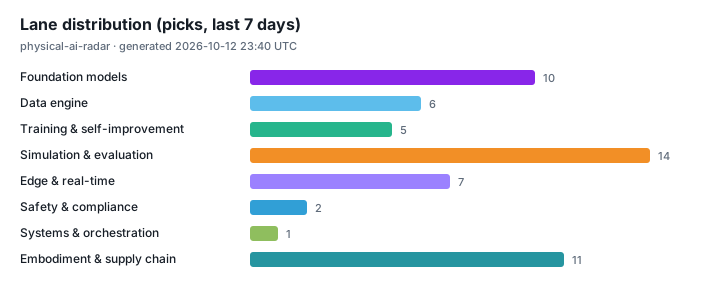
Lane distribution
| Lane | # |
|---|---|
| Foundation models (VLA / WAM) | 3 |
| Data engine (collection / curation / scaling) | 6 |
| Training & self-improvement (RL / post-training) | 5 |
| Simulation & evaluation (sim2real / closed-loop) | 5 |
| Edge & real-time (on-device inference / control rate) | 7 |
| Safety, authority & compliance | 5 |
| Systems & orchestration (long-horizon / multi-policy) | 3 |
| Embodiment & supply chain (hardware / cost) | 3 |
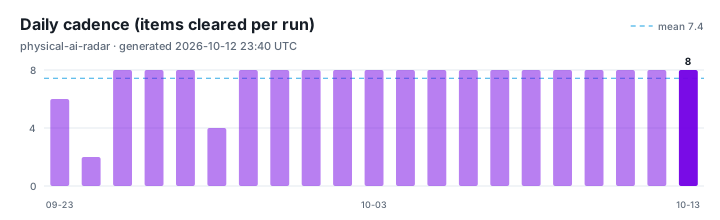
Recent cadence

Standards & compliance watch
- ISO 25785-1 — Safety requirements for dynamically stable industrial mobile robots — Under development; committee-stage as of 2026-09.
- Regulation (EU) 2023/1230 (Machinery Regulation) — Fully applicable 2027-01-20.
- EU AI Act official timeline (Council of the EU) — High-risk deadlines 2027-12-02 / 2028-08-02 per Digital Omnibus.
This repository is technical observation. It is not investment advice, a product commitment, or a safety certification conclusion. Paper claims are author-reported.